Saudi-Based Falcon Vision Group Eyes $10 Billion Investment in Pakistan
 By hanif sabir
Published: 30 Jul 2026
6 min read
By hanif sabir
Published: 30 Jul 2026
6 min read
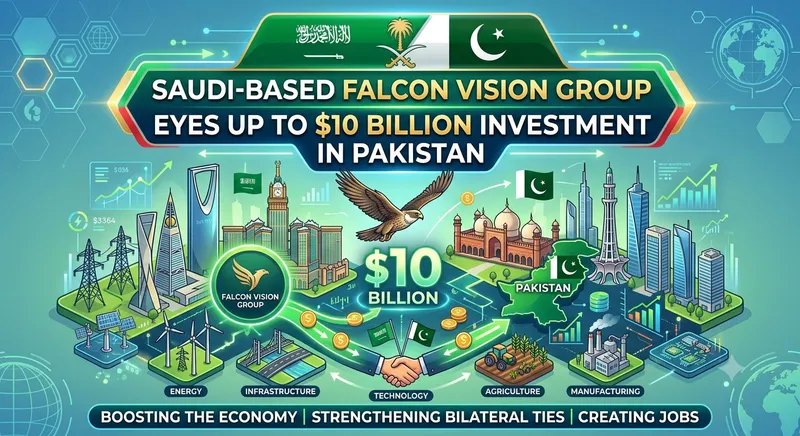
ISLAMABAD (special crosspondent) – Saudi-based Falcon Vision Group has expressed interest in investing up to $10 billion in Pakistan across multiple sectors, as the Federal Minister for Board of Investment (BOI), Qaiser Ahmed Sheikh, assured a high-level delegation of the government’s full support and facilitation for foreign and local investors. The Federal Minister for BOI held an important meeting with a delegation comprising business leaders, overseas Pakistanis and media professionals to discuss investment opportunities in Pakistan and ways to promote investment in various sectors. The delegation included Rasheed Khan Niazi, former Director Current Affairs at PTV Islamabad; Muhammad Tariq Ghous, Vice Chairman/President of Falcon Vision Company, Jeddah, Saudi Arabia; Zulfiqar, Business Head of Falcon Vision Pakistan; Dr. Asmat Ullah Khan, PhD in Mass Communication and Country Head of Falcon Vision; Maqbool, associated with real estate projects including J7 Emporium; Col. Jamshed; and Attique, an overseas Pakistani based in Korea involved in the luxury automobile business. Senior officials of the Board of Investment also participated in the meeting. Welcoming the delegation, Federal Minister Qaiser Ahmed Sheikh reaffirmed that the Board of Investment remains fully committed to facilitating investors at every stage of their investment journey. He said the Government of Pakistan was pursuing a proactive and investor-friendly policy regime aimed at attracting foreign direct investment, supporting businesses and promoting economic growth.
Strategic Investment Interests
During the meeting, Muhammad Tariq Ghous briefed the Federal Minister about the operations and business interests of Falcon Vision Company, a diversified Saudi-based business group headquartered in Jeddah, Kingdom of Saudi Arabia. He said the group has interests in infrastructure, construction, technology and various industrial sectors, adding that Saudi investors were actively exploring investment opportunities in Pakistan. According to Ghous, up to $10 billion has been earmarked for potential investment in Pakistan across various sectors. Welcoming the expression of interest, Minister Qaiser Ahmed Sheikh termed it a strong indication of confidence in Pakistan’s economic potential and investment climate. He said Pakistan offered a vast and dynamic market with significant opportunities in a wide range of sectors, supported by its young population and strategic geographical location. The minister highlighted the incentives available to investors in Special Economic Zones (SEZs), saying that these zones provide highly attractive facilities, including income tax exemption until 2035 and duty-free import of plant and machinery. He also highlighted the role of Business Facilitation Centers (BFCs), which are operating as one-stop, single-window platforms designed to streamline business processes, including registrations, licensing and approvals. Qaiser Ahmed Sheikh further said Pakistan’s investment framework allows 100 percent repatriation of profits and provides a non-discriminatory policy for both local and foreign investors. He said the Board of Investment serves as the custodian of the country’s investment policy and remains committed to facilitating investors.
Addressing Economic Hurdles and Future Projects
The minister acknowledged that investors still face challenges, particularly related to energy costs and procedural bottlenecks, but assured the delegation that the government was actively working to address these issues. He also highlighted the Board of Investment’s leading role in regulatory reforms through the Cabinet Committee on Regulatory Reforms (CCoRR), which he chairs. The committee is working to simplify procedures, remove unnecessary regulatory hurdles and improve the overall ease of doing business in Pakistan. During the meeting, Maqbool briefed the minister on his real estate ventures, including J7 Emporium, and shared plans to establish a Special Technology Zone (STZ). He stressed the importance of aligning Special Technology Zones with Special Economic Zones in order to accelerate industrial development through capacity building. In response, the Federal Minister explained that SEZ regulations had been amended to allow greater participation by the private sector. Under the amended framework, private entities can develop and manage SEZs subject to prescribed requirements. The minister clarified, however, that while the establishment of new zones is currently restricted, investors can take advantage of existing notified areas, with the Board of Investment ready to provide full facilitation. Qaiser Ahmed Sheikh also appreciated the invitation to visit J7 Emporium and encouraged further cooperation in the fields of real estate and commercial development.
Regional Development and Cultural Tourism
BOI officials invited the delegation to visit the Business Facilitation Center to see firsthand how the single-window system operates and how it is designed to improve the efficiency of business-related processes. During the meeting, Col. Jamshed briefed the minister about a joint project with Maqbool to establish a modern shopping mall in Chakwal. He highlighted the district’s literacy rate of more than 97 percent and pointed to the presence of the University of Chakwal, which has a significant student population. According to Col. Jamshed, these factors demonstrate the strong human-resource potential of Chakwal and provide a favorable environment for commercial development. The Federal Minister appreciated the initiative and wished the project’s sponsors success. Maqbool also briefed the minister on plans to develop a Gandhara Club near Taxila, aimed at promoting religious and cultural tourism, particularly for Buddhist visitors. He said there was growing international interest in projects related to the Gandhara heritage, including the possibility of investment in resorts and educational institutions. The minister welcomed the proposal and said Pakistan possessed vast but largely untapped potential in the tourism sector. Drawing on his own business background and experience in international joint ventures, including collaborations with Korean and Malaysian partners, Qaiser Ahmed Sheikh said he understood the requirements and concerns of investors. He also emphasized that Pakistan’s policy framework supports passive capital inflows, making the country potentially beneficial even for investors who wish to park their capital in the country. Concluding the meeting, Federal Minister Qaiser Ahmed Sheikh assured the delegation of his full accessibility to investors, saying that he personally remained available to investors and would ensure prompt response and facilitation on investment-related matters. He encouraged the delegation and other investors to remain engaged with the Board of Investment and approach it whenever support or facilitation was required. The Board of Investment reiterated its commitment to facilitating investors, improving the business environment and positioning Pakistan as a preferred global investment destination.