PM Orders Fast-Track OGRA Reforms, Digital Monitoring of Petroleum Supply Chain
 By hanif sabir
Published: 31 Jul 2026
Updated: 03 Aug 2026
3 min read
By hanif sabir
Published: 31 Jul 2026
Updated: 03 Aug 2026
3 min read
PM Orders Fast-Track OGRA Reforms, Digital Monitoring of Petroleum Supply Chain
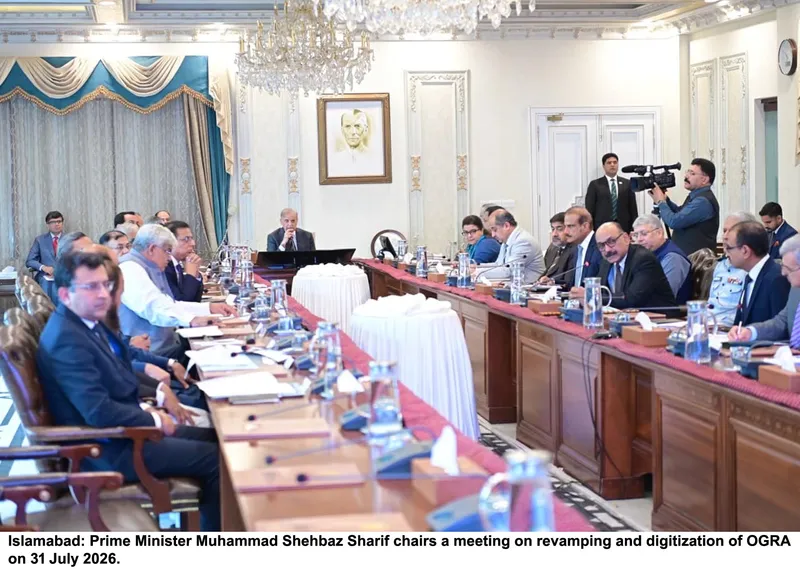
ISLAMABAD, July 31: Prime Minister Shehbaz Sharif on Friday directed the swift implementation of wide-ranging reforms in the Oil and Gas Regulatory Authority (OGRA), emphasizing greater transparency, stronger regulatory oversight, and enhanced institutional capacity to ensure an efficient and accountable petroleum sector.
Chairing a high-level meeting on the restructuring and digital transformation of OGRA, the prime minister said the government’s reform agenda must be implemented uniformly across all public institutions. He instructed the relevant authorities to develop a nationwide fuel movement monitoring system based on the Federal Board of Revenue’s (FBR) modern tracking model to improve transparency and operational efficiency.
The prime minister also called for the deployment of advanced digital technologies and software to monitor the entire petroleum supply chain—from ports and oil refineries to storage depots, transportation networks, and petrol stations—in real time. He said digital oversight would help eliminate irregularities, improve accountability, and ensure uninterrupted fuel supplies across the country.
To strengthen OGRA’s institutional capacity, Shehbaz Sharif directed that qualified professionals from the private sector be recruited through a transparent, merit-based process as part of the authority’s restructuring. He assured that the government would provide all necessary technical and professional support to make the reform programme successful.
Reaffirming the government’s commitment to protecting public resources, the prime minister said every rupee of taxpayers’ money must be safeguarded and warned that no individual or company would be allowed to exploit consumers through hoarding, profiteering, or manipulation of the petroleum supply system.
He also instructed all regulatory authorities to establish formal coordination mechanisms with their respective ministries and directed that work on upgrading Pakistan’s oil refineries under the approved refinery policy be accelerated.
During the meeting, OGRA Chairman briefed participants on the authority’s performance, key operational challenges, and a comprehensive reform strategy. Officials informed the prime minister that significant progress had already been made in digitizing the petroleum supply chain through the National Monitoring Dashboard, Tanker Track and Trace System, Depot Tank Telemetry, Rahguzar Mobile Application, Digital Sales Entry System at petrol stations, and a Central Monitoring Cell.
The meeting was told that these digital platforms are enabling more effective monitoring of petroleum products throughout transportation, storage, and retail sales. Officials also informed the prime minister that a data-driven enforcement campaign conducted during July 2026 uncovered several cases of fuel hoarding, unnecessary supply disruptions, and regulatory violations. Show-cause notices were issued to those involved, while legal proceedings were initiated where required.
The meeting reviewed OGRA’s broader reform agenda, including digitalization, restructuring of the enforcement mechanism, establishment of a dedicated compliance wing, improvements in the licensing framework, stronger legal management, enhanced financial resources, and institutional reorganization.
Appreciating the proposed reforms, Prime Minister Shehbaz Sharif directed that the digital monitoring system be made fully operational at the earliest to eliminate hoarding and profiteering while ensuring complete transparency in the oil and gas sector. He reiterated that uninterrupted fuel supplies and fair prices for consumers remain among the government’s top priorities and made it clear that negligence, corruption, or regulatory violations would not be tolerated.
The meeting was attended by Deputy Prime Minister and Foreign Minister Senator Mohammad Ishaq Dar, Federal Ministers Azam Nazeer Tarar, Dr. Musadik Malik, Ahad Khan Cheema, Attaullah Tarar, Shaza Fatima Khawaja, Ali Pervaiz Malik, Special Assistant to the Prime Minister Tariq Bajwa, and other senior government officials.