Mark e Haq — First Anniversary of a Defining Strategic Conflict
 By Executive Editor
Published: 06 May 2026
Updated: 30 Jun 2026
4 min read
By Executive Editor
Published: 06 May 2026
Updated: 30 Jun 2026
4 min read
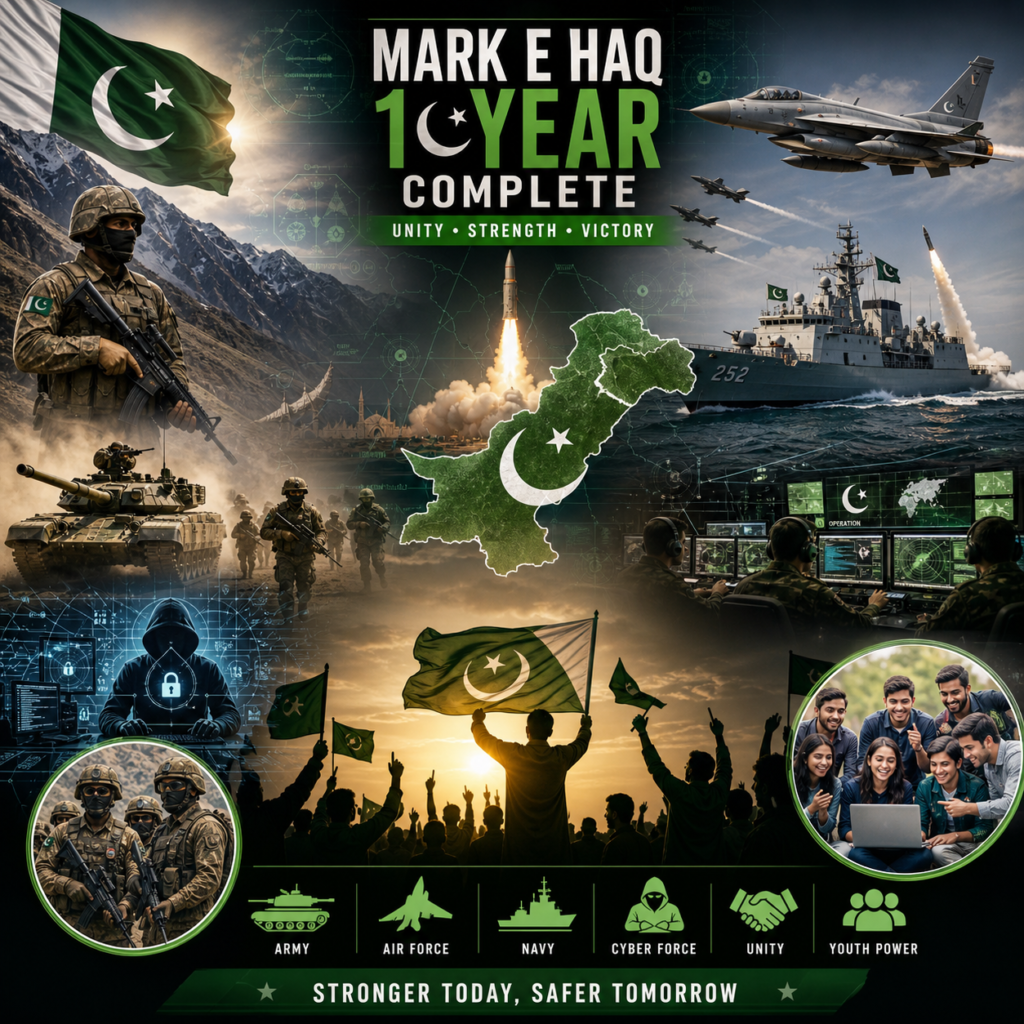
Mark e Haq was not merely a military confrontation. It became a defining strategic moment that demonstrated Pakistan’s defense preparedness, operational coordination, technological capability, and national unity
In May 2025, South Asia once again entered a dangerous phase of regional tension. Following developments after April 22, 2025, diplomatic pressure, military activity, media escalation, and intelligence operations increased sharply between Pakistan and India.
International defense observers warned that the situation could evolve into a limited but serious military confrontation.
That warning became reality during the night of May 6–7, 2025, when escalating tensions transformed into what later became known as Mark e Haq.
Now, as the first anniversary of Operation Bunyan-ul-Marsoos approaches on May 10, 2026, defense experts continue to analyze the conflict as one of the most important modern military episodes in recent regional history.
From Rising Tensions to Military Confrontation
During the final weeks of April 2025:
- Military alert levels increased
- Border surveillance intensified
- Air activity expanded significantly
- Intelligence coordination accelerated
Global media organizations and strategic think tanks closely monitored the rapidly changing situation.
After military escalation on May 6, Pakistan responded with a coordinated strategy involving rapid deployment, technological integration, and multi-domain operational planning.
Operation Bunyan-ul-Marsoos
On May 10, 2025, Pakistan launched Operation Bunyan-ul-Marsoos.
The operation represented more than a traditional military response. It reflected a modern strategic doctrine focused on:
- Rapid operational coordination
- Controlled escalation
- Real-time intelligence sharing
- Precision targeting
- Defensive deterrence
According to ISPR statements released during the operation, multiple strategic military targets were engaged through coordinated actions.
Defense analysts described the operation as an example of modern multi-domain warfare, combining land, air, naval, cyber, and intelligence capabilities into one integrated operational framework.
Technology and the Future of Warfare
One of the most significant lessons from Mark e Haq was the growing importance of technology in modern warfare.
The conflict highlighted the use of:
- Drone surveillance systems
- Satellite-based intelligence
- Cyber monitoring
- Precision-guided weapons
- Digital command-and-control systems
Security experts noted that Pakistan demonstrated elements of network-centric warfare, where multiple military units operate through integrated digital communication systems.
This showed how future conflicts will depend not only on military hardware, but also on data superiority, communication speed, and cyber capability.
The Role of the Pakistan Air Force
Military observers considered the Pakistan Air Force one of the key operational components during the conflict.
Analysts highlighted:
- Continuous aerial surveillance
- Fast-response operational readiness
- Advanced air defense coordination
- Strategic airspace management
The Air Force played a major role in maintaining deterrence and operational balance during the crisis.
Naval and Cyber Dimensions
Pakistan Navy maintained strategic maritime readiness throughout the confrontation.
At the same time, cyber defense emerged as an equally critical battlefield.
Modern defense experts increasingly emphasize that national security now includes protection of:
- Digital infrastructure
- Communication systems
- Cyber networks
- Strategic data systems
Mark e Haq reinforced the idea that cyber warfare is now an essential component of military strategy.
Pakistan’s Diplomatic Strategy
Alongside military operations, Pakistan maintained an active diplomatic approach.
Pakistan:
- Briefed international powers
- Presented its position globally
- Called for regional stability
- Maintained controlled official communication
As a result, many international observers viewed Pakistan’s approach as relatively balanced and strategically measured.
National Unity — The Defining Factor
One of the most powerful aspects of Mark e Haq was the unity displayed across Pakistan.
During the conflict:
- Citizens expressed strong support for the Armed Forces
- Social media became a platform for national solidarity
- Young people actively countered misinformation campaigns
Defense Minister Khawaja Asif described the nation as “a wall of unity standing beside its Armed Forces,” a phrase that reflected the public mood during the crisis.
Information Warfare and Media Strategy
The conflict also highlighted the growing importance of media and digital narratives in modern warfare.
Pakistan focused on:
- Verified information
- Responsible communication
- International media engagement
- Controlled strategic messaging
At the same time, misinformation and digital propaganda became major challenges throughout the conflict.
Lessons After One Year
The first anniversary of Mark e Haq offers several major strategic lessons:
Modern wars are technology-driven
National unity remains the strongest strategic asset
Cyber warfare is now a reality
Diplomacy and military strength must work together
Youth awareness is part of national defense
The Road Ahead
Defense analysts believe Pakistan’s future strategic priorities will likely include:
- Advanced defense technology
- Stronger cyber security systems
- Indigenous defense production
- Intelligence modernization
- Youth awareness programs
- Regional diplomatic engagement
Conclusion
Mark e Haq was not merely a military confrontation. It became a defining strategic moment that demonstrated Pakistan’s defense preparedness, operational coordination, technological capability, and national unity.
One year later, the conflict continues to shape discussions about regional security and modern warfare.
Its most important lesson remains clear:
National security is not protected by weapons alone, but by unity, discipline, technology, awareness, and strategic vision.