Federal Constitutional Court Orders Recognition of Reinstated Employees as Regular Employees, Directs Implementation of Supreme Court Ruling
 By hanif sabir
Published: 01 Nov 2026
4 min read
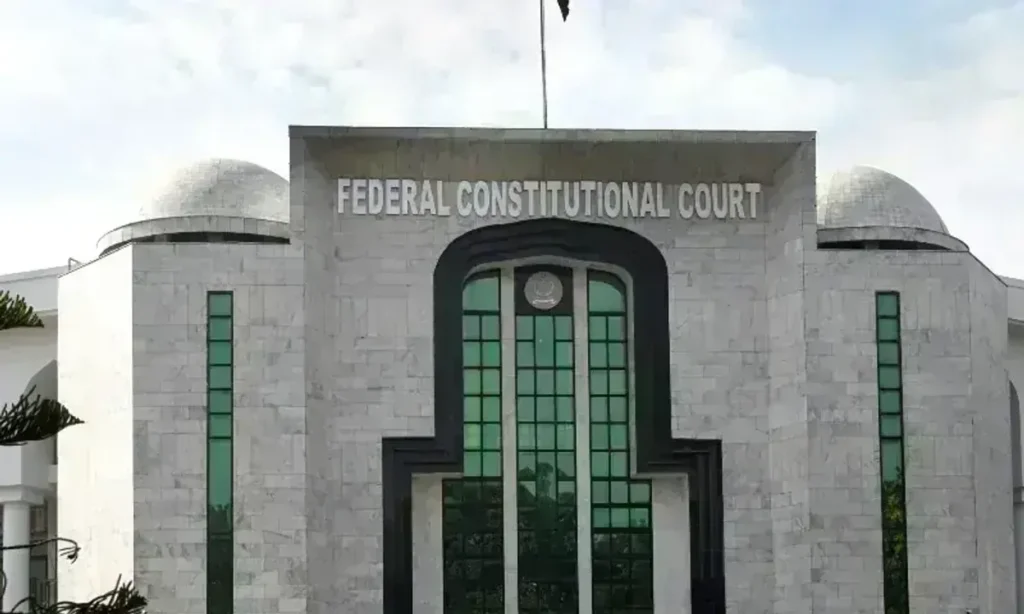
Federal Constitutional Court Orders Recognition of Reinstated Employees as Regular Employees, Directs Implementation of Supreme Court Ruling
*ISLAMABAD (3D Media):* The Federal Constitutional Court of Pakistan has directed the relevant authorities to unconditionally recognise the petitioners as regular employees and implement the Supreme Court’s December 17, 2021 judgment in its letter and spirit.
The court disposed of several contempt of court petitions concerning the non-implementation of the Supreme Court’s ruling, directing the respondents to recognise the petitioners as regular employees entitled to the benefits specified in the earlier judgment.
The three-member bench comprised Chief Justice Amin-ud-Din Khan, Justice Ali Baqar Najafi and Justice Syed Arshad Hussain Shah. Justice Ali Baqar Najafi authored the judgment.
The court observed that orders issued by the Supreme Court are not merely recommendations but constitute a legal mandate that the government and relevant institutions are constitutionally bound to implement. Delays in complying with judicial decisions undermine the rule of law and public confidence in the judicial system.
The case arose from the Supreme Court’s December 17, 2021 judgment in Civil Review Petition No. 292 of 2021, through which 108 review petitions, 35 civil miscellaneous applications and three civil miscellaneous appeals had been dismissed. The proceedings related to the case titled *Muhammad Afzal v. Secretary Establishment Division*.
In its judgment, the Supreme Court had laid down conditions for the reinstatement of employees dismissed between November 1, 1996, and October 12, 1999.
Under the ruling, employees holding positions that did not require educational qualifications or specialised skills tests were to be reinstated under the same terms and conditions that applied at the time of their dismissal. Other employees, whose positions required specific qualifications or skills tests, were required to pass the relevant examination conducted by the Federal Public Service Commission (FPSC).
The detailed judgment further directed that reinstated employees seeking to continue in service must appear in and pass the relevant Public Service Commission examination within three months of receiving the judgment.
The Federal Constitutional Court noted that the issue of conducting the required tests for reinstated employees had remained unresolved in ten organisations, including the Intelligence Bureau (IB), Commissionerate for Afghan Refugees, Khyber Pakhtunkhwa, National Highway Authority (NHA), Pakistan Telecommunication Company Limited (PTCL), Overseas Pakistanis Foundation (OPF), State Life Insurance Corporation (SLIC), Civil Aviation Authority (CAA), Water and Power Development Authority (WAPDA), Sui Southern Gas Company Limited (SSGC) and Trading Corporation of Pakistan (TCP).
The court was informed that neither the relevant departments nor the Federal Public Service Commission had arranged the required examinations for these employees.
The departments maintained that the employees themselves had not expressed willingness to appear in the tests, whereas the employees argued that issuing advertisements and making arrangements for the examinations were the responsibility of the relevant departments.
The judgment also took into account that several employees had continued serving for more than ten years following their reinstatement, while some were approaching retirement.
The court observed that employees should not be made to suffer the consequences of administrative failures when the failure to conduct the required examinations was not attributable to them.
Emphasising the importance of the rule of law in a constitutional democracy, the court held that compliance with Supreme Court judgments was a constitutional obligation rather than a matter of administrative discretion. It further observed that non-compliance with judicial orders damages public confidence in the judiciary and the overall system of governance.
While disposing of Criminal Contempt Petitions Nos. 1, 3, 4 and 22 of 2024, along with the connected proceedings, the Federal Constitutional Court directed the respondents to implement the Supreme Court’s December 17, 2021 judgment in its letter and spirit and unconditionally recognise the petitioners as regular employees entitled to the benefits of the ruling.
The judgment was announced in open court in Islamabad following hearings held on July 30 and 31, 2026.