Israel Approves Legal Framework for International Security Force in Gaza
 By hanif sabir
Published: 27 Jul 2026
2 min read
By hanif sabir
Published: 27 Jul 2026
2 min read
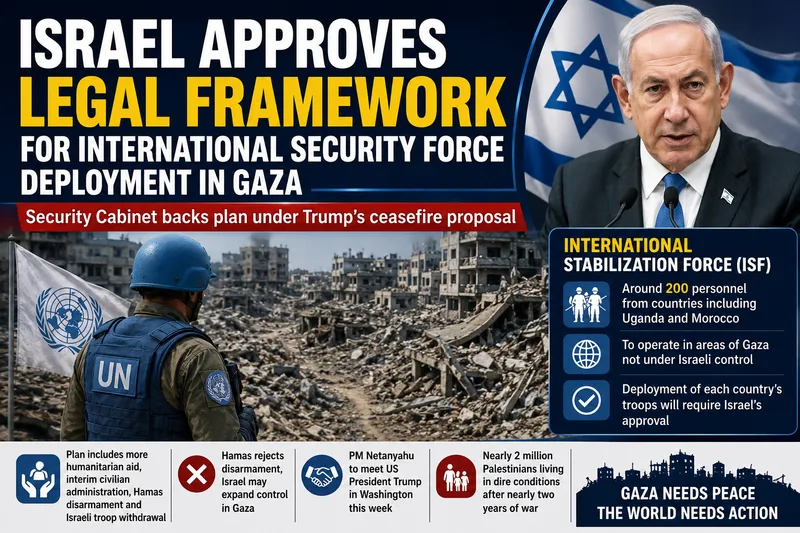
TEL AVIV (special crosspondent) – Israel has officially approved a legal framework facilitating the potential deployment of an international security force within the Gaza Strip, forming a central pillar of the ceasefire initiative proposed by US President Donald Trump, according to recent media reports.
The Israeli Security Cabinet has formally endorsed this framework, establishing the operational foundation for the proposed International Stabilization Force (ISF) to operate within the conflict-ridden territory. The strategy aims to bridge the security gap in regions currently beyond direct Israeli control as discussions regarding regional security architecture continue to evolve.
Operational Structure of the Proposed Force
Under the terms of the proposal, the ISF is expected to comprise approximately 200 personnel sourced from nations identified as friendly toward Israel, with initial reports suggesting the involvement of countries such as Uganda and Morocco. A critical condition of the agreement dictates that the deployment of any participating nation’s personnel remains subject to explicit approval by the Israeli government, ensuring a level of oversight that aligns with Tel Aviv’s security parameters.
Israeli Prime Minister Benjamin Netanyahu is slated to travel to Washington shortly, where he is scheduled to hold high-level talks with US President Donald Trump. Their dialogue is expected to center on the evolving Gaza situation and the broader parameters of the proposed ceasefire plan, amidst efforts to align international efforts similar to how stakeholders pursue multilateral cooperation in other global theatres.
Humanitarian Crisis and Strategic Hurdles
The US-backed roadmap for peace reportedly includes a significant surge in humanitarian aid delivery, the creation of an interim civilian administration governed by Palestinian technocrats, the complete disarmament of Hamas, and a phased withdrawal of Israeli defense forces. Despite these framework details, implementation remains heavily contested. Hamas has thus far maintained a firm rejection of disarmament mandates, while Israel has simultaneously signaled that it may opt to expand the territory currently under its active military control.
The humanitarian backdrop remains grim, as nearly two years of sustained conflict have left much of Gaza’s infrastructure in ruins. Reports indicate that approximately two million Palestinians are currently residing in precarious conditions, inhabiting makeshift tents or severely damaged structures, highlighting the urgent need for a resolution comparable to the relief efforts often managed by the Emergency Response Committee during regional crises.