Saudi Arabia Launches Multinational Maritime Defence Alliance with 13 Countries
 By hanif sabir
Published: 14 Aug 2026
4 min read
By hanif sabir
Published: 14 Aug 2026
4 min read
Saudi Arabia Launches Multinational Maritime Defence Alliance with 13 Countries
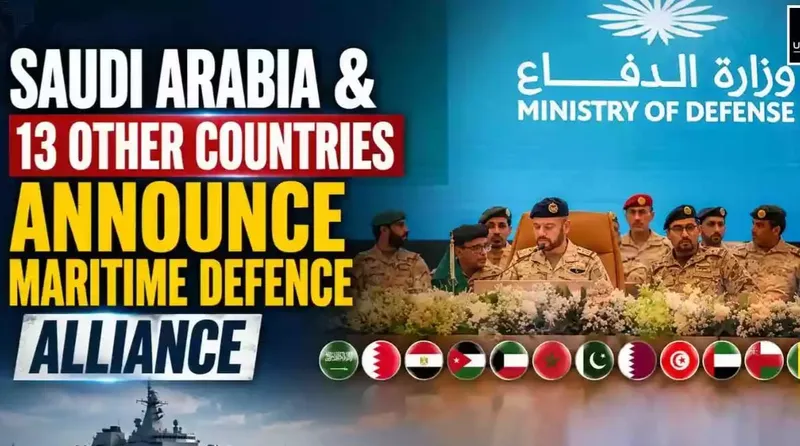
RIYADH: Saudi Arabia has formally moved ahead with a multinational maritime defence alliance involving 14 countries, including Pakistan, aimed at strengthening maritime security and safeguarding freedom of navigation through the Red Sea, the Bab al-Mandeb Strait and the Gulf of Aden.
The alliance brings together Saudi Arabia, Pakistan, Türkiye, Egypt, Jordan, Kuwait, Qatar, Bahrain, Bangladesh, Djibouti, Somalia, Sudan, Comoros and Yemen. The founding countries have agreed to cooperate in protecting vital international trade and energy routes in the region.
The establishment of the alliance was announced following a meeting in Riyadh on July 30, when representatives of participating countries endorsed a joint declaration establishing the Multinational Maritime Defence Alliance. Saudi Arabia is set to host the alliance’s headquarters. Representatives from 43 countries attended the meeting, out of 51 countries invited by Riyadh.
The alliance is designed to strengthen collective maritime defence cooperation and protect international shipping and energy supply routes passing through some of the world’s most strategically important waterways.
The Bab al-Mandeb connects the Red Sea with the Gulf of Aden and the wider Indian Ocean, making it a critical maritime corridor for global trade. Any prolonged disruption in the area can have significant consequences for shipping, energy supplies, insurance costs and international supply chains.
Under the framework, participating countries are expected to cooperate through intelligence and information sharing, operational planning, joint exercises and maritime operations. However, the founding declaration does not specify how many naval vessels, aircraft or other military assets each country will contribute.
The alliance has been described by the participating countries as defensive in nature. The founding states have stressed that it does not target any particular country, alliance or international organization and that its activities will be conducted in accordance with international law and respect for national sovereignty.
The development comes amid heightened security concerns in the Red Sea and surrounding waters, particularly following repeated attacks on commercial shipping by Yemen’s Houthi movement. The group has previously targeted vessels in the Red Sea and surrounding waterways, disrupting one of the principal maritime routes between Asia, Europe and the Middle East.
Saudi Arabia has increasingly focused on strengthening maritime security as attacks and regional tensions have posed risks to its trade and energy infrastructure. The Kingdom’s western coastline and Red Sea ports are also becoming increasingly important to its economic diversification strategy under Vision 2030.
Saudi Arabia’s decision to establish the alliance comes alongside its broader efforts to develop regional defence partnerships. Riyadh has also deepened security cooperation with Pakistan and Türkiye through the recently signed Makkah Joint Defence Agreement. Reuters reported that Saudi Arabia is increasingly relying on regional defence partnerships as it seeks to strengthen its security posture amid escalating tensions in the Middle East.
Pakistan’s participation is particularly significant because of its location along the Arabian Sea and its experience in multinational maritime security operations. Pakistan is among the founding countries supporting the Saudi-led initiative and is expected to participate in efforts aimed at strengthening maritime security and protecting commercial shipping.
Türkiye has also confirmed its participation in efforts to establish the maritime coalition. Turkish officials have said Ankara supports initiatives aimed at securing Red Sea shipping routes and countering threats to freedom of navigation.
The alliance is now moving toward an operational phase. Reports indicate that the participating countries are preparing to integrate personnel into multinational command, maritime and intelligence structures, with joint operational mechanisms being developed. Saudi Arabia has also appointed a commander for the multinational maritime defence coalition.
The initiative also leaves the door open for additional countries to join after completing their respective national procedures. Saudi Arabia has emphasized that maritime security is a shared responsibility and that coordination among states is essential for confronting common and transnational maritime threats.
The United Arab Emirates and Oman, despite their strategic positions in the region and their longstanding interest in maritime security, were not among the countries listed as founding supporters of the declaration.
The effectiveness of the new alliance will ultimately depend on how successfully its members coordinate naval assets, intelligence, surveillance, command structures and rules for joint operations. For now, the formation of the 14-nation coalition represents a significant Saudi-led effort to create a regional mechanism for protecting maritime trade and energy routes in the Red Sea, Bab al-Mandeb and Gulf of Aden.
With Saudi Arabia hosting the headquarters and countries including Pakistan, Türkiye and Egypt participating, the alliance could become an important component of the emerging regional security architecture if its planned joint command and operational arrangements are successfully implemented.