North African Green Energy Projects to Power European Electricity Grid
 By hanif sabir
Published: 19 Jul 2026
3 min read
By hanif sabir
Published: 19 Jul 2026
3 min read
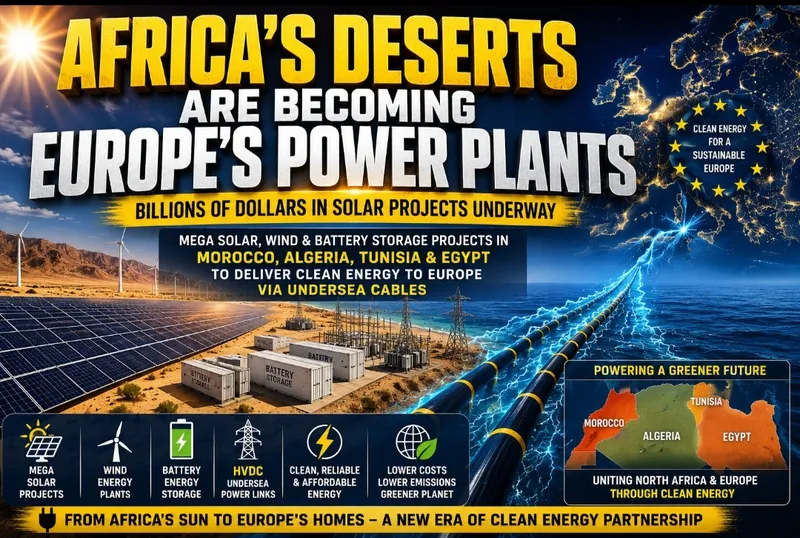
BRUSSELS (special crosspondent) – Europe is rapidly advancing an ambitious strategy to transform North Africa into a major renewable energy hub as it seeks to strengthen energy security, reduce dependence on fossil fuels and accelerate its transition to a low-carbon economy. This strategic shift mirrors global efforts to optimize infrastructure, much like how Pakistan Solar Battery Imports Surge Amid Rising Energy Demand Trends, demonstrating the universal necessity for robust energy storage solutions.
Multi-Billion-Dollar Green Energy Expansion
Multi-billion-dollar investments are being directed toward large-scale solar, wind and battery energy storage projects across Morocco, Algeria, Tunisia and Egypt. The electricity generated by these facilities is expected to be transmitted to Europe through High Voltage Direct Current (HVDC) undersea cables, creating one of the world’s largest cross-border clean energy networks.
Geopolitical Drivers and Renewable Commitment
According to international energy reports, Europe’s drive for energy diversification intensified after recent geopolitical crises exposed the risks of relying heavily on imported natural gas. At the same time, the continent’s commitment to achieving net-zero emissions by 2050 has increased investment in renewable energy partnerships beyond its borders.
Strategic Advantages of North Africa
North Africa has emerged as a strategic choice because of its vast desert landscapes, abundant year-round sunshine, strong wind resources and proximity to European markets. These natural advantages allow renewable electricity to be produced at highly competitive costs.
Key Regional Initiatives
Morocco is leading the transition, with plans for a direct electricity interconnection with France. The project is designed to transmit renewable electricity generated from Moroccan solar and wind farms into the French grid and eventually across the wider European electricity network.
The European Union is also supporting the Medlink initiative, which aims to install around 10 gigawatts of solar, wind and battery storage capacity in Algeria and Tunisia. The project is expected to generate approximately 30 terawatt-hours of electricity annually while adding 4 gigawatts of new transmission capacity between North Africa and Europe.
Egypt is emerging as another key player through a planned undersea electricity interconnector with Greece. Once completed, the link will enable Egyptian renewable electricity to flow directly into the European grid. Italy and Tunisia are also moving forward with a separate HVDC interconnection project that will further strengthen energy integration across the Mediterranean.
Implications for Global Energy Markets
Energy analysts believe these projects will not only improve Europe’s energy security but also help stabilize electricity prices, reduce carbon emissions and decrease dependence on imported fossil fuels. Collectively, they are expected to reshape the Mediterranean into one of the world’s most important clean energy corridors.
Experts say the developments also offer valuable lessons for countries such as Pakistan. With world-class solar resources in Balochistan, Sindh and Cholistan, Pakistan has significant potential to expand renewable energy generation. Analysts argue that long-term investment in transmission infrastructure, battery storage and supportive energy policies could eventually enable the country to meet domestic demand more efficiently and even export electricity to regional markets, potentially mirroring the success seen in sectors like the Pakistan and Japan Strengthen Ties in AI and Startup Innovation framework for technology transfer.