Pakistan Secures 629 Million Dollars in Landmark China Pharmaceutical Deals
 By hanif sabir
Published: 22 Jul 2026
3 min read
By hanif sabir
Published: 22 Jul 2026
3 min read
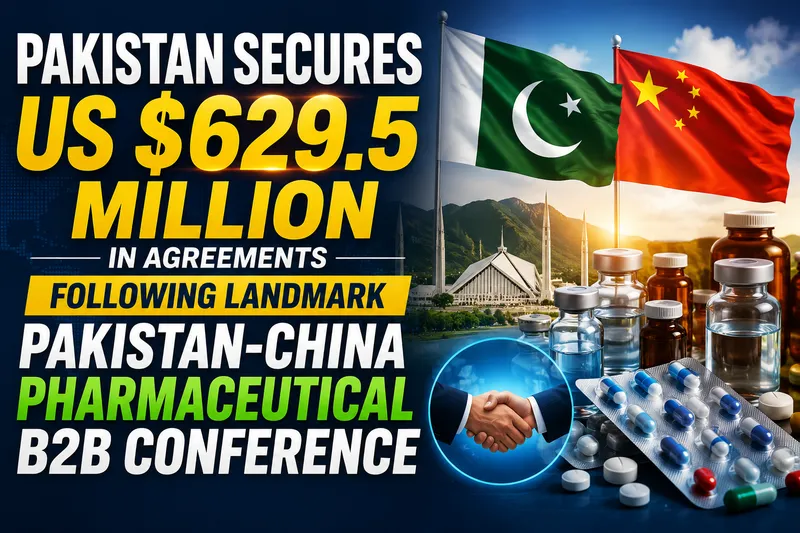
ISLAMABAD (special crosspondent) – Pakistan has secured commercial agreements worth US$629.5 million following the successful Pakistan-China Pharmaceutical Business-to-Business (B2B) Conference, Federal Minister for National Health Services, Regulations and Coordination Syed Mustafa Kamal announced on Tuesday. Addressing a press conference, the minister described the conference as a landmark achievement in the government’s efforts to transform Pakistan’s pharmaceutical industry into a globally competitive sector by attracting foreign investment, strengthening local manufacturing, promoting technology transfer, and reducing dependence on imported medicines, an effort that parallels recent government initiatives like those noted in Finance Minister Aurangzeb’s discussions on priority investment projects.
Strategic Outcomes of the B2B Conference
“The purpose of sharing this success is to present a positive image of Pakistan to our people and the world. While challenges exist, it is equally important to highlight achievements that restore confidence in Pakistan’s economy and investment potential,” the minister said. The two-day conference, held in Islamabad on July 17–18, brought together 240 Chinese delegates representing 140 leading pharmaceutical companies and 430 Pakistani delegates from 210 local companies, making it one of the largest Pakistan-China pharmaceutical business engagements ever organized. To maximize business outcomes, the Ministry of National Health Services facilitated six weeks of virtual business matchmaking before the conference, enabling companies to enter the event with advanced business discussions rather than introductory meetings. As a result, the conference generated 340 bilateral business meetings, leading to 22 commercial agreements worth US$629.5 million and 84 Memoranda of Understanding (MoUs) with an estimated value of nearly US$800 million, many of which are expected to evolve into formal investment agreements.
Key Sectors and Local Vaccine Production
The agreements cover six key sectors, including active pharmaceutical ingredients (APIs), local vaccine production, clinical trials, generic formulations, injectable medicines, and medical device manufacturing. Mustafa Kamal emphasized that the government’s focus extends beyond signing MoUs, aiming instead to ensure legally binding commercial agreements that generate tangible investments, technology transfer, industrial growth, and employment opportunities. The minister also announced that Pakistan has approved its first National Local Vaccine Production Policy, laying the foundation for domestic vaccine manufacturing. He noted that all 13 vaccines currently used under Pakistan’s national immunization programme are imported, and the new policy aims to enhance health security while reducing import dependence. He said Pakistan is also working with Chinese partners to develop the country’s clinical trials ecosystem, promote Traditional Chinese Medicine, expand local medical device manufacturing, establish technical training programmes, and begin indigenous production of APIs. Currently, Pakistan manufactures nearly 85 percent of finished pharmaceutical products locally but imports around 95 percent of the raw materials used in medicine production.
Regulatory Reforms and Digital Integration
Highlighting regulatory reforms, the minister said that around 85 percent of the Drug Regulatory Authority of Pakistan’s (DRAP) processes have now been digitized, significantly reducing approval times, improving transparency, minimizing human intervention, and enhancing the ease of doing business. Registration of medical devices, which previously took years, can now be completed online within 20 days, he added. The minister praised the contributions of Pakistan’s Embassy in Beijing, DRAP, the Trade Development Authority of Pakistan (TDAP), the Board of Investment (BOI), the Ministry of Information and Broadcasting, Islamabad Police, and other institutions for ensuring the success of the conference. Concluding the briefing, Mustafa Kamal described the conference as the beginning of a long-term strategic partnership between Pakistan and China in the healthcare and pharmaceutical sectors, reaffirming the government’s commitment to implementing the signed agreements and converting them into operational projects that strengthen Pakistan’s pharmaceutical industry, create jobs, increase exports, and support sustainable economic growth.