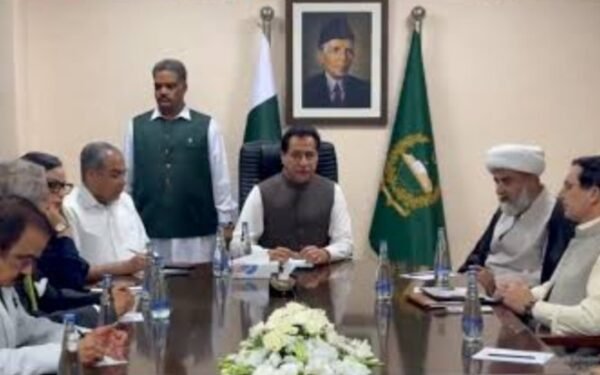
Commerce Minister Jam Kamal Khan Prioritizes SME Growth and Exports
 By hanif sabir
Published: 30 Jul 2026
3 min read
By hanif sabir
Published: 30 Jul 2026
3 min read

ISLAMABAD (special crosspondent) – Federal Minister for Commerce Jam Kamal Khan convened a comprehensive meeting with a delegation from the Gujranwala Small Chamber of Commerce to address the multi-faceted challenges currently impacting Pakistan’s Small and Medium Enterprises (SMEs). The discussion focused on critical areas including export diversification, industrial competitiveness, broader access to finance, and systemic regulatory reforms.
Empowering the Industrial Backbone
Minister Jam Kamal Khan underscored the government’s commitment to the SME sector, characterizing it as the fundamental backbone of Pakistan’s manufacturing landscape. He highlighted the sector’s indispensable role in driving employment generation, fostering industrial development, and sustaining national export growth. The Minister affirmed that revitalizing these enterprises remains a paramount priority for the administration.
Export Strategies and Regional Challenges
The visiting delegation briefed the Minister on the significant impediments created by regional geopolitical tensions and global logistical disruptions, specifically citing the impact of unrest in the Red Sea on traditional trade routes to Saudi Arabia, the UAE, Bahrain, and Kuwait. Echoing global concerns similar to those highlighted in recent reports on Saudi Arabia’s call for a global coalition against Houthi threats, the delegation emphasized the urgent need to pivot toward emerging markets, particularly within Africa. The Ministry was urged to facilitate business-to-business (B2B) engagements and state-backed trade delegations to secure new commercial frontiers.
Jam Kamal Khan expressed optimism regarding Africa’s economic trajectory, noting that the continent’s rising population and demand for affordable consumer goods offer a strategic window for Pakistan’s engineering, metalwork, home appliance, and light manufacturing industries.
Addressing Structural and Financial Constraints
The dialogue also delved into the escalating costs of doing business. Industry representatives identified high energy tariffs, complex tax structures, limited credit availability, and obsolete manufacturing technology as primary barriers. The Minister noted that the government is actively prioritizing the industrial transition toward modern, efficient machinery.
Regarding financial liquidity, the Minister highlighted that the Export-Import (EXIM) Bank of Pakistan is currently scaling up its credit guarantee facilities. He encouraged local businesses to engage with commercial banks for EXIM-backed solutions, promising that the Ministry would resolve any bureaucratic hurdles preventing access to these essential financial tools.
Regulatory Reform and Future Policy
The delegation raised critical issues regarding sales tax refund delays and the scarcity of high-quality raw materials. In response, Jam Kamal Khan reaffirmed that the government is aggressively pursuing regulatory streamlining. A high-level committee, operating under the Prime Minister’s directives, is currently reviewing redundant licensing procedures with the goal of full-scale digitalization to eliminate unnecessary approvals.
Emphasizing the importance of an equitable marketplace, the Minister agreed that the expansion of the formal economy is essential for sustainable growth. He stated that the government aims to create a level playing field that rewards tax-compliant entities over undocumented competitors. The meeting concluded with the Minister inviting the Gujranwala Small Chamber of Commerce to submit a formal, detailed proposal for policy reforms, assuring that the Ministry of Commerce will provide every possible support to bolster the sector’s competitiveness.