China Achieves Historic Milestone with First Commercial Brain Chip Implant
 By hanif sabir
Published: 17 Jul 2026
2 min read
By hanif sabir
Published: 17 Jul 2026
2 min read
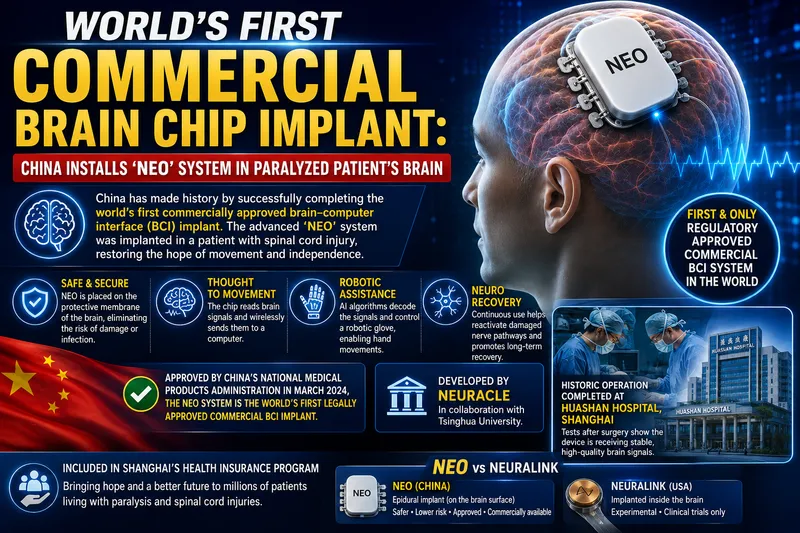
SHANGHAI (special crosspondent) – In a landmark achievement for medical science and neurotechnology, China has successfully completed the world’s first implantation of a commercially approved brain-computer interface (BCI) system. The groundbreaking procedure was performed at Huashan Hospital, affiliated with Fudan University in Shanghai, where surgeons implanted the advanced NEO (Neural Electronic Opportunity) system into the brain of a patient who had lost the use of both hands due to a spinal cord injury.
Breakthrough in Clinical Application
According to the hospital, the device began receiving stable, high-quality brain signals immediately after surgery, and the patient remains in stable condition. The operation has attracted global attention because China has become the first country to commercially deploy an approved brain-chip technology. While Elon Musk’s Neuralink is still undergoing clinical trials, China’s National Medical Products Administration approved the NEO system for commercial medical use earlier this year, making it the world’s first legally approved commercial brain implant.
Technical Innovations of the NEO System
The NEO system was developed by Shanghai-based neurotechnology company Neuracle in collaboration with researchers from Tsinghua University. Unlike Neuralink, whose electrodes are inserted directly into brain tissue, the Chinese system is placed on top of the brain’s protective membrane—a procedure known as epidural placement. This method significantly reduces the risk of damage to brain tissue and minimizes the potential for infection.
Functionality and Future Implications
The technology converts a patient’s thoughts directly into physical movement. When the patient thinks about moving a hand or grasping an object, the implanted chip records brain signals and wirelessly transmits them to an external computer. Artificial intelligence algorithms decode the signals and send commands to a pneumatic robotic glove worn by the patient, enabling the hand to perform grasping and movement functions. Medical experts believe the technology not only provides immediate assistance but may also help reactivate damaged neural pathways through repeated use, potentially improving long-term neurological recovery. To make the treatment more accessible, the Shanghai municipal government has included the NEO system under its local health insurance program, offering new hope to millions of people living with paralysis and spinal cord injuries.