Finance Minister Muhammad Aurangzeb Discusses Bilateral Economic Ties With Natalie Baker
 By hanif sabir
Published: 10 Aug 2026
2 min read
By hanif sabir
Published: 10 Aug 2026
2 min read
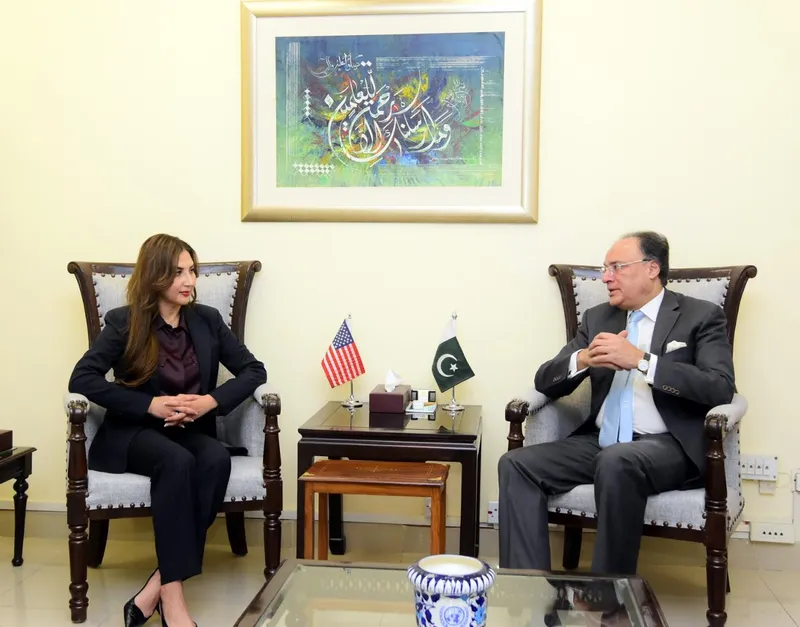
ISLAMABAD (special crosspondent) – Federal Minister for Finance and Revenue, Senator Muhammad Aurangzeb, held a high-level meeting with the U.S. Chargé d’Affaires to Pakistan, H.E. Ms. Natalie Baker, at the Finance Division today to deliberate on the expansion of Pakistan–U.S. economic relations and avenues for strengthening bilateral cooperation.
Overview of Recent Engagements
The Finance Minister provided a detailed briefing on his recent mission to Washington, where he engaged with the U.S. Secretary of the Treasury, the International Monetary Fund (IMF), the U.S. International Development Finance Corporation (DFC), and the U.S. Export-Import Bank (EXIM). This dialogue mirrors broader regional efforts to foster connectivity, similar to recent proposals like the Russia Seeks Rail Link to Indian Ocean via Afghanistan, Pakistan and India initiative, underscoring Pakistan’s strategic focus on financial stability.
Trade and Investment Frameworks
Senator Aurangzeb highlighted the progress made during discussions with the Office of the United States Trade Representative (USTR) regarding a reciprocal trade framework. The Minister expressed a firm commitment to advancing this framework to secure enhanced market access and promote export-led growth. Furthermore, the discussion shifted to the role of technology and innovation in economic development. With emerging sectors like artificial intelligence becoming focal points for global advancement, the Minister noted that Pakistan is actively seeking to improve its investment landscape for high-tech U.S. firms.
Economic Reforms and Stabilization
The Finance Minister detailed the government’s ongoing efforts to diversify financing sources and improve foreign exchange reserves. He highlighted the implementation of a new daily price revision mechanism for petroleum products as a key step toward aligning domestic markets with international conditions. Ms. Baker acknowledged these proactive measures, affirming U.S. support for Pakistan’s economic reform agenda. The discussion also touched upon the necessity of institutional strengthening, a core component of the current fiscal strategy, reminiscent of other significant infrastructure and energy projects like the Gulpur Hydropower Project: NEPRA Approves 30-Year Tariff of 9 which aim to stabilize the national economy.
Future Outlook
Both parties reaffirmed their commitment to fostering a private-sector-friendly environment. Senator Aurangzeb emphasized that identifying investment-ready projects remains a priority, while Ms. Baker reiterated the U.S. government’s intent to encourage increased participation from American corporations across the energy, logistics, and digital technology sectors.