Pakistan Hydropower Projects Face Soaring Costs Amid Inflation and Delays
 By hanif sabir
Published: 27 Jul 2026
3 min read
By hanif sabir
Published: 27 Jul 2026
3 min read
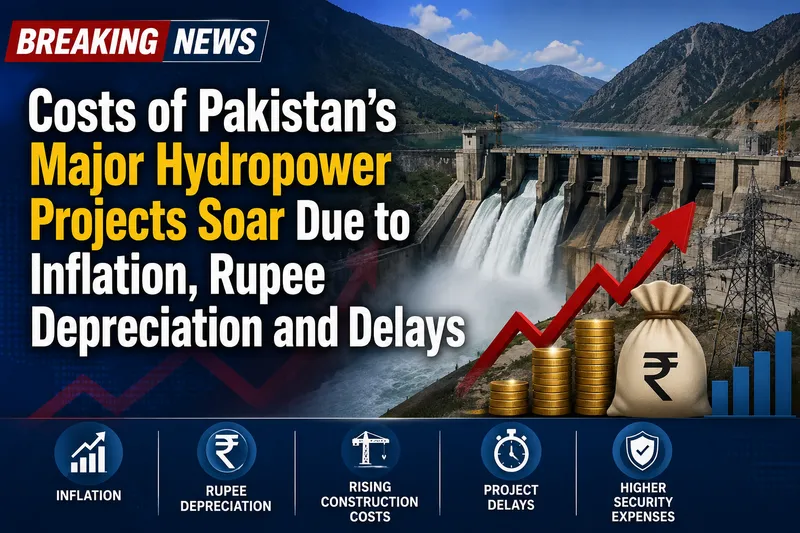
ISLAMABAD (special crosspondent) – The cost of several of Pakistan’s flagship hydropower projects has increased sharply, with the Ministry of Water Resources attributing the escalation to inflation, depreciation of the Pakistani rupee, project delays, rising security expenses, design revisions, and higher construction costs. According to details presented by the ministry, major projects including the Diamer Bhasha Dam, Mohmand Dam, Dasu Hydropower Project (Stage-I), Tarbela 5th Extension, and Greater Karachi Bulk Water Supply Scheme (K-IV) Phase-I have all experienced substantial cost overruns, mirroring the fiscal challenges currently impacting various national sectors, such as Pakistan’s textile industry concerns.
Diamer Bhasha and Mohmand Dam Escalations
The Diamer Bhasha Dam project has recorded a 134 per cent increase in cost, rising from Rs479.69 billion to Rs1.122 trillion. Officials said the revision reflects changes in exchange rates, inflation, updated engineering designs, revised consultancy contracts, enhanced security arrangements, land acquisition costs, and an extension of the project’s completion deadline to December 2030. Similarly, the estimated cost of the Mohmand Dam has more than doubled, increasing by 115 per cent from Rs309.56 billion to Rs665.74 billion. The ministry cited higher construction costs, rupee depreciation, inflation, revised contractor rates, security expenditures, and design modifications as key factors behind the increase.
Dasu Hydropower and Tarbela 5th Extension
The Dasu Hydropower Project (Stage-I) has witnessed one of the largest increases, with its cost climbing 260 per cent from Rs486.09 billion to Rs1.738 trillion. According to the ministry, most of the increase resulted from factors beyond the control of the executing agency, including exchange rate fluctuations, inflation, additional security measures, social safeguard requirements, and financing costs during construction. The cost of the Tarbela 5th Extension project has also surged by 285 per cent, rising from Rs82.36 billion to Rs316.41 billion. Officials noted that the original estimates were prepared over a decade ago and no longer reflected prevailing market prices. Escalating costs of civil works, electro-mechanical equipment, transmission infrastructure, and delays in implementation further contributed to the revised estimate.
K-IV Project and Broader Economic Pressures
Meanwhile, the K-IV Phase-I water supply project for Karachi has seen its cost increase by 36 per cent, mainly due to inflation, higher import costs for mechanical equipment, implementation delays, and additional security requirements. The Ministry of Water Resources stated that economic pressures, including persistent inflation and exchange rate volatility, have significantly impacted the financial viability of large infrastructure projects. The government maintains that revised cost estimates are necessary to ensure the completion of these strategic projects, which are essential for the nation’s energy security and water resources management. The issue has also drawn the attention of the Auditor General of Pakistan (AGP), whose Audit Report 2024-25 highlighted financial irregularities involving billions of rupees in WAPDA’s hydropower projects, prompting renewed calls for stronger financial oversight and improved project management, similar to calls for government commitment to empowering the SME sector.