Saudi Oil Export Routes Under Pressure as Alternative Capacity Nears Limits
 By hanif sabir
Published: 03 Aug 2026
3 min read
By hanif sabir
Published: 03 Aug 2026
3 min read
Saudi Oil Export Routes Under Pressure as Alternative Capacity Nears Limits
RIYADH: Saudi Arabia is facing growing pressure on alternative routes for exporting crude oil, as heightened tensions around the Strait of Hormuz and security risks in the Red Sea have increasingly constrained the kingdom’s options for moving oil to global markets.
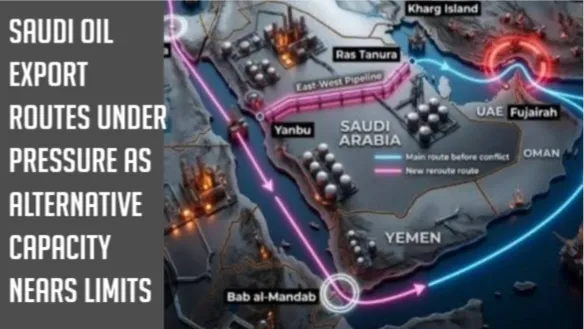
According to OilPrice, Saudi Arabia redirected a significant portion of its crude flows from its eastern coast to the western coast after shipping through the Strait of Hormuz was disrupted. The move was aimed at using the Red Sea as an alternative export route, but threats from the Houthis against shipping have made that route increasingly difficult to use.
The report said Saudi Arabia began moving large volumes of its Arab Light crude to the western port of Yanbu in March after maritime traffic through the Strait of Hormuz was disrupted amid tensions involving Iran. The kingdom used the Petroline pipeline, which has a capacity of around 7 million barrels per day.
The shift resulted in a sharp increase in Saudi crude exports from Yanbu. In March, exports from the port reached around 2.47 million barrels per day, about 330% higher than pre-conflict levels.
Exports from Yanbu exceeded 4 million barrels per day in April, but fell to around 2.39 million barrels per day by June. That was 41% below the March peak and around 66% lower than Saudi Arabia’s total daily crude exports in January.
According to the report, maritime activity through the Strait of Hormuz partially recovered following a temporary ceasefire between Iran and the United States at the end of June. However, renewed tensions once again disrupted shipping. On July 29, only five tankers entered the Strait of Hormuz while three exited.
Security threats in the Red Sea have also forced Saudi oil tankers to alter their routes. Instead of sailing south from Yanbu, vessels are increasingly heading north to avoid areas considered vulnerable to attacks. As a result, the Suez Canal and Egypt’s SUMED pipeline have emerged as key alternative routes for Saudi crude exports.
However, the capacity of these routes is limited. The SUMED pipeline can transport around 2.5 million barrels of oil per day, while the Suez Canal’s oil transport capacity is estimated at about 1 million barrels per day. Some of SUMED’s capacity is also already committed to other countries.
OilPrice reported that Saudi Arabia has also begun using large crude carriers to transport oil from Yanbu to Egypt’s Ain Sokhna port. From there, crude can be moved through the SUMED pipeline to the Mediterranean coast, while the Sidi Kerir terminal can be used to ship Saudi crude onward to Asian buyers.
Analysts, however, say the Suez Canal and SUMED pipeline cannot fully handle Saudi Arabia’s previous export volumes. If security risks in the Red Sea persist, Saudi crude exports could come under further pressure in the coming weeks.
Higher global oil prices have provided some financial relief to Saudi Arabia. According to the report, Brent crude prices have risen by around 47% since the beginning of the year. Despite a roughly 25% decline in Saudi oil production during the second quarter, oil revenues increased by 28% compared with the first quarter.
OilPrice’s analysis suggests that Saudi Arabia’s main challenge is increasingly shifting from crude production to transporting its oil safely and efficiently to international markets. Growing pressure on the Strait of Hormuz, the Red Sea, the Suez Canal and alternative pipelines could pose new geographic and security risks not only to Saudi exports but also to global oil supplies.