Syria Seeks Security Pact with Israel, Retains Golan Heights Claim
 By hanif sabir
Published: 27 Jul 2026
3 min read
By hanif sabir
Published: 27 Jul 2026
3 min read
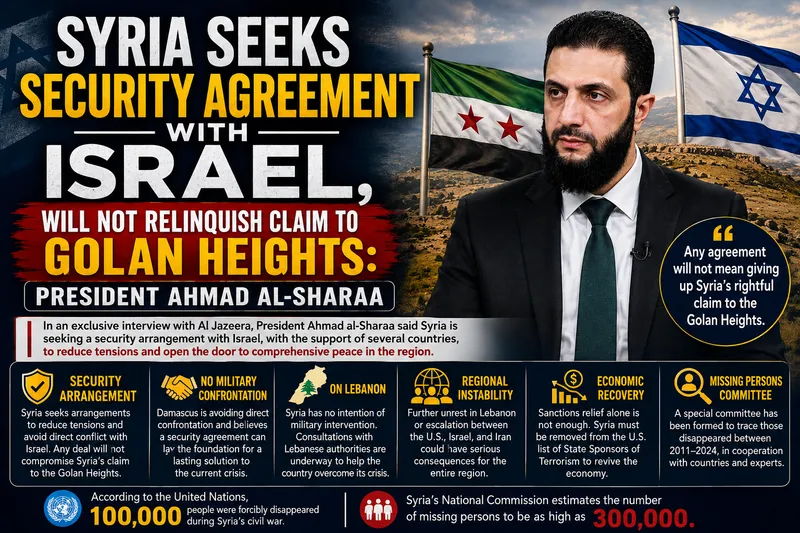
DAMASCUS (special crosspondent) – Syrian President Ahmad al-Sharaa has announced that his government is currently engaged in discussions with various regional and international stakeholders to secure a comprehensive security arrangement with Israel. The President framed this initiative as a critical step toward mitigating ongoing military tensions and establishing a foundation for broader regional stability in the Middle East. However, President al-Sharaa remained steadfast in his commitment to national sovereignty, emphasizing that such an arrangement does not constitute a renunciation of Syria’s territorial claim to the Israeli-occupied Golan Heights.
Diplomatic Avenues and Territorial Claims
In an exclusive interview, President al-Sharaa articulated that Damascus is actively pursuing security frameworks designed to minimize military friction between the two nations, prevent further escalatory conflict, and eventually facilitate a pathway toward a long-term peace settlement. He noted that while avoiding direct military confrontation is a current priority to ensure regional stability, Syria’s historical stance regarding the Golan Heights remains non-negotiable.
These diplomatic overtures emerge against a backdrop of increased Israeli airstrikes and cross-border military operations in southern Syria, which have intensified following the collapse of the Bashar al-Assad regime in December 2024. The new Syrian administration has consistently characterized these military actions as egregious violations of state sovereignty.
Regional Security and Economic Revitalization
Addressing the volatile situation in neighboring Lebanon, President al-Sharaa clarified that Syria harbors no intent to intervene militarily. Instead, Damascus is engaged in ongoing consultations with Lebanese authorities to address the nation’s multifaceted political and economic crises. The President reaffirmed his support for the principle that strategic decisions regarding national defense and foreign policy should remain the sole prerogative of the Lebanese state. He warned that any further instability in Lebanon would inevitably have adverse effects on Syria, while cautioning that heightening tensions between the United States, Israel, and Iran could have devastating regional consequences.
Turning to domestic economic recovery, al-Sharaa stated that the mere lifting of international and US-imposed sanctions would be insufficient to revitalize the fractured Syrian economy. He formally called for Syria’s removal from the US list of State Sponsors of Terrorism, asserting that such a measure is essential for the restoration of international banking channels, the attraction of foreign direct investment, and the facilitation of large-scale national reconstruction projects. Comparable efforts for regional stabilization are often debated in contexts similar to government-led economic empowerment initiatives across emerging markets.
Domestic Reconciliation and Transitional Justice
President al-Sharaa provided updates regarding the implementation of agreements with the Syrian Democratic Forces (SDF) in northern and eastern regions of the country. Despite reported delays in the transition, the government maintains its commitment to restoring central state authority. Furthermore, the administration has inaugurated a special national committee tasked with investigating the fate of individuals who disappeared during the civil war period from 2011 to 2024.
This committee is mandated to operate in accordance with international standards, leveraging global expertise to trace the missing. Data from the United Nations suggests that approximately 100,000 individuals were subjected to enforced disappearances, while national estimates place this figure as high as 300,000. Analysts emphasize that addressing these humanitarian concerns is a prerequisite for national reconciliation and enduring peace. Similar institutional accountability measures remain a challenge for governments globally, as seen in complex administrative restructuring efforts like the ongoing reforms in state-operated sectors.
Ultimately, as the country navigates its post-conflict trajectory, observers remain focused on whether such diplomatic maneuvering can withstand the pressures of regional geopolitical shifts. Much like the regulatory and policy shifts observed in global trade landscapes, Syria’s path to recovery will depend on its ability to align domestic policy with the demands of an international order in transition.