Iran Turns to Rail Route to Supply Oil to China as Seaborne Exports Fall by 70%
 By hanif sabir
Published: 16 Aug 2026
4 min read
By hanif sabir
Published: 16 Aug 2026
4 min read
Iran Turns to Rail Route to Supply Oil to China as Seaborne Exports Fall by 70%
Tehran: Iran has begun exploring alternative land routes to maintain oil exports amid disruptions to maritime trade and mounting pressure around the Strait of Hormuz. The efforts include attempts to transport some oil to China by rail, although experts say rail transport cannot fully replace maritime shipments.
According to The Wall Street Journal, Iran’s crude oil loadings fell to around 567,000 barrels per day between April 14 and 23, down from an average of about 2 million barrels per day in February. The figures were attributed to energy analytics firm Kpler.
Following disruptions to maritime exports, Iran has also started reusing old and inactive storage tanks to hold unsold crude. Hamid Hosseini, a spokesman for Iran’s Oil Exporters Union, said efforts were underway to use rail connections to reach Chinese cities including Yiwu and Xi’an.
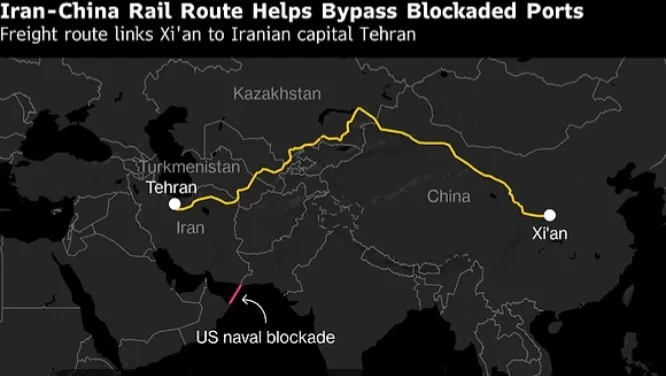
Possible rail route from Iran to China
Available information indicates that the potential land route runs from northeastern Iran into Turkmenistan and then through the Central Asian rail network toward China.
The possible route can broadly be described as:
Iran → Turkmenistan → Central Asia → China
However, different reports have described the route differently, and no single rail line has been confirmed as the definitive route. Hosseini has referred to rail connections reaching Yiwu and Xi’an in China.
The 567,000 barrels per day figure is not rail shipments
An important clarification is that the figure of 567,000 barrels per day does not represent the amount of oil being transported to China by rail. It refers to Iran’s overall seaborne crude oil loading during the period cited.
This means Iran’s maritime oil export activity fell by roughly 70% compared with its February average. Only a limited portion of Iran’s oil is being considered for transportation by rail.
Rail can provide only a limited alternative
Experts say rail could help Iran move a limited amount of oil to China during the disruption, but it cannot replace the millions of barrels transported by oil tankers.
A large oil tanker can carry millions of barrels of crude, while moving comparable volumes by rail would require a very large number of tanker wagons and continuous train operations.
China remains Iran’s key oil customer
China is Iran’s most important crude oil buyer. According to The Wall Street Journal, around 90% of Iran’s crude oil exports have historically been destined for China.
This makes alternative land routes to China particularly important for Tehran as maritime exports face growing disruptions.
Pressure on Iran’s oil storage capacity
The sharp decline in exports has created another major challenge for Iran: storage capacity.
If oil production continues while exports remain restricted, storage facilities could quickly reach their limits. Iran has therefore begun reusing older storage tanks to accommodate crude that cannot immediately be exported.
Kpler has warned that if the disruption continued, Iran could eventually be forced to reduce oil production, putting additional pressure on government revenues and the country’s energy sector.
Pakistan is not part of the main rail route
It is important to note that Pakistan is not a primary part of the rail route currently being discussed for transporting Iranian oil to China.
The potential land corridor runs mainly from northeastern Iran through Turkmenistan and Central Asia before reaching China.
Overall, Iran’s efforts to move oil to China by rail represent an emergency attempt to maintain access to its most important customer amid severe disruptions to maritime exports. However, because of the limited capacity of rail transport, it cannot serve as a full replacement for the traditional seaborne route.