Pakistan Begins Assembly of First Commercial Containership in Forty Years
 By hanif sabir
Published: 10 Jul 2026
3 min read
By hanif sabir
Published: 10 Jul 2026
3 min read
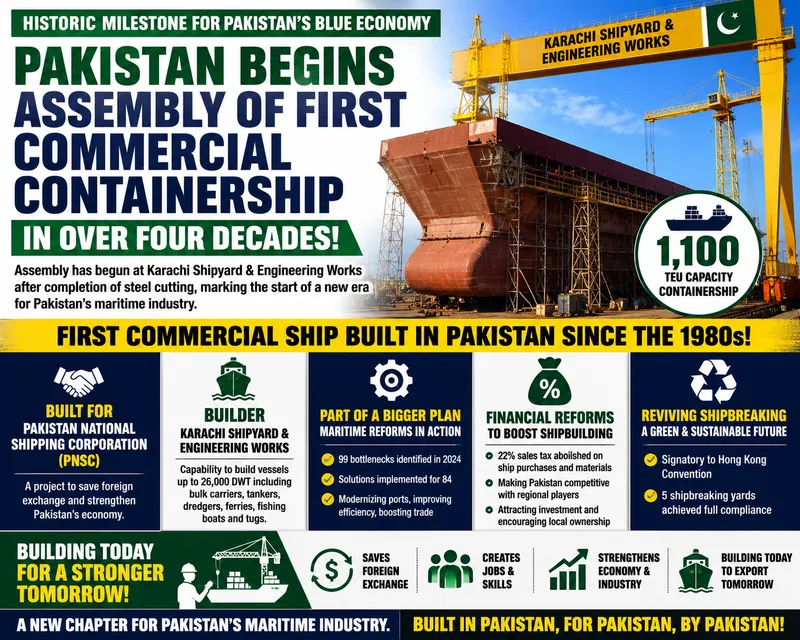
KARACHI (special crosspondent) – Pakistan has officially entered a new phase in the revitalization of its maritime industry, commencing the assembly of the nation’s first large-scale commercial containership in over four decades. This milestone represents a strategic pivot toward bolstering the country’s blue economy and reducing long-standing reliance on international shipyards.
The 1,100-TEU container vessel is currently being constructed by the Karachi Shipyard & Engineering Works (KS&EW) on behalf of the state-owned Pakistan National Shipping Corporation (PNSC). By domesticating the manufacturing process, the government aims to preserve critical foreign exchange reserves while simultaneously creating high-skilled jobs within the domestic industrial sector. Similar to efforts aimed at improving broader economic partnerships, such as the Pakistan-Türkiye Business Meeting Proposed to Boost Trade, this project underscores a commitment to national industrial self-reliance.
Project Background and Historical Context
Assembly work progressed following the successful completion of initial steel-cutting operations, which began in January 2026. Although the initiative was originally proposed in 2024, implementation was temporarily stalled due to fiscal constraints before a renewed government focus expedited the project timeline. This vessel marks the first commercial ship produced domestically since the industry’s decline in the 1980s. Historically, the Karachi Shipyard has pivoted its focus toward the production of naval hardware, successfully delivering frigates, corvettes, and logistics support ships for the Pakistan Navy. Despite the long hiatus in the commercial sector, the facility maintains the technical infrastructure to construct vessels up to 26,000 deadweight tons (DWT).
Government Policy and Maritime Reforms
The containership project is a cornerstone of a broader government roadmap launched in 2024 to unlock Pakistan’s latent maritime potential. A special maritime task force identified 99 systemic hurdles currently impeding the sector; authorities confirm that 84 of these issues have already been mitigated. Similar proactive measures are being explored across various sectors, including ongoing discussions on Pakistan and Croatia Explore Port Partnerships and Economic Ties to diversify economic corridors.
In a move to enhance industrial competitiveness, the government has eliminated the 22 percent sales tax previously levied on ship purchases and raw materials. This policy shift is intended to place local yards on a level playing field with regional competitors, such as India, which offer substantial industry subsidies. Furthermore, the administration is actively modernizing port infrastructure by streamlining customs clearance, deploying advanced scanning technologies, and transitioning to 24/7 port operations.
Sustainable Shipbreaking and Future Outlook
Beyond new construction, Pakistan is aggressively reforming its shipbreaking industry. By adopting the Hong Kong International Convention for the Safe and Environmentally Sound Recycling of Ships, the nation has already seen five shipbreaking yards achieve full regulatory compliance. These integrated reforms are designed to bolster the national industrial base, generate employment, and eventually transform Pakistan into a regional exporter of commercial vessels, as the country seeks to integrate more effectively into the global supply chain.