Non-Muslim Nations Lead Global Halal Market Amid Trade Deficit Crisis
 By hanif sabir
Published: 13 Jul 2026
2 min read
By hanif sabir
Published: 13 Jul 2026
2 min read
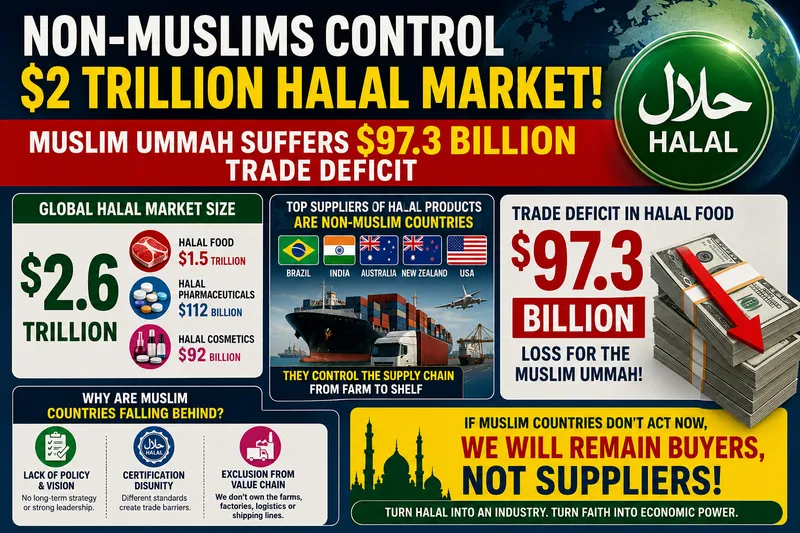
ISLAMABAD (special crosspondent) – Non-Muslim countries have secured a commanding position within the global halal economy, resulting in a staggering trade deficit of more than US$97.3 billion for the Muslim world in the food sector alone. Although the global Muslim population of nearly two billion people forms the primary consumer base for this multi-trillion-dollar industry, the majority of the economic benefits are currently being captured by non-Muslim producers and exporters.
Global Market Dynamics and Economic Scale
Recent international data estimates the total value of the global halal consumer economy at approximately US$2.6 trillion. This figure comprises US$1.5 trillion in halal food, US$112 billion in pharmaceuticals, and US$92 billion in the cosmetics sector. Despite these significant figures, the leading suppliers within the global halal value chain remain countries such as Brazil, India, Australia, New Zealand, and the United States, rather than the major nations of the Muslim world.
The Dominance of Non-Muslim Exporters
Brazil currently holds the position of the world’s largest exporter of halal meat and poultry. Similarly, India has successfully transformed its halal meat exports into a vital source of foreign exchange, having shipped more than 1.2 million metric tons of buffalo meat to predominantly Muslim markets during the 2024–25 fiscal year. Furthermore, the integration of advanced traceability systems and robust logistics networks has significantly bolstered the market share of Australia and New Zealand in this competitive sector.
Structural Challenges and Future Outlook
Analysts identify the absence of cohesive, long-term industrial policies and the existence of fragmented halal certification standards as primary hurdles preventing growth in Muslim nations. Furthermore, limited ownership of critical segments of the value chain—such as high-capacity processing facilities, cold-chain logistics, and global shipping networks—remains a major barrier. Experts have emphasized that nations like Pakistan and Bangladesh must prioritize investment in infrastructure and adopt comprehensive export strategies to transition from mere consumers to key producers. As Ahsan Iqbal Highlights Pakistan’s Economic Stability and Future Development Goals, such economic maturity is vital for regional progress. Ultimately, industry leaders argue that the halal market must be recognized not merely as a religious certification, but as a fundamental pillar for industrial and economic strength within the Muslim world.