Pakistan Denounces India’s Kashmir Annexation as State Terrorism at UN
 By hanif sabir
Published: 06 Aug 2026
2 min read
By hanif sabir
Published: 06 Aug 2026
2 min read
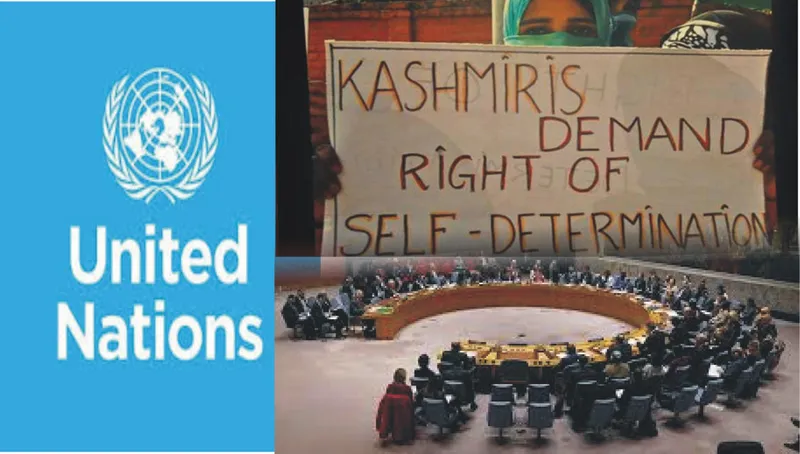
UNITED NATIONS (special crosspondent) – Pakistan told the UN Security Council Wednesday that India’s annexation of occupied Jammu and Kashmir seven years ago, enforced by 90,000 Indian troops, represents the “worst example of state terrorism.”
Kashmir and Global Security
“Today, 5 August marks a grim occasion – it is the seventh anniversary of the unlawful and unilateral measures imposed in Indian-illegally occupied Jammu and Kashmir,” Ambassador Asim Iftikhar Ahmad, permanent representative of Pakistan to the UN, said in a debate on ‘Threats to international peace and security caused by terrorist acts’, while underscoring the need for intensive international cooperation and practical action to fight the menace. Pakistan remains steadfast in its solidarity with the Kashmiri people, who have endured over seven decades of injustice and a denial of their fundamental right to self-determination, the envoy noted.
Pakistan, he added, maintains a policy of zero-tolerance for such blatant perpetration of state terrorism. “The international community must not allow counter-terrorism to be misused as a pretext to suppress the legitimate struggles of peoples against foreign occupation and for their inalienable right to self-determination,” he stated.
Concerns Regarding Afghanistan
Addressing the situation in Afghanistan, Ambassador Asim Ahmad noted that since the Taliban’s takeover in 2021, an increasingly permissive environment has allowed terror groups to launch attacks in Pakistan with active external support. “Safe havens are available inside Afghanistan to terrorist groups such as TTP, BLA, its Majeed Brigade, ISIL-K, ETIM, and Al Qaeda affiliates,” he said. He stressed that regional stability remains a priority, and the Taliban must be held accountable for ensuring Afghan territory is not used to threaten other states.
Global Counter-Terrorism Efforts
Discussing the broader fight against extremism, the envoy emphasized that terrorism cannot be defeated by states acting in isolation. He called for enhanced border management and robust mechanisms to disrupt terrorist financing, including through virtual assets. Furthermore, strengthening security infrastructure remains vital to addressing evolving threats.
Briefing the 15-member Council, Oguljeren Niyazberdiyeva, Chief of the Office of the Under-Secretary-General for Counter-Terrorism, noted that despite international efforts, Da’esh continues to pose a significant threat to global security. Presenting the twenty-third report of the Secretary-General on ISIL/Da’esh, she highlighted that terrorist groups are increasingly exploiting advances in artificial intelligence and digital technologies while operating across borders. She concluded that the group’s structure remains resilient, often exploiting fragile security environments to sustain its activities.