US-Canada Tariff Talks Collapse, Canada Announces Retaliatory Measures Against Trump’s 50% Tariffs
 By hanif sabir
Published: 23 Aug 2026
4 min read
By hanif sabir
Published: 23 Aug 2026
4 min read
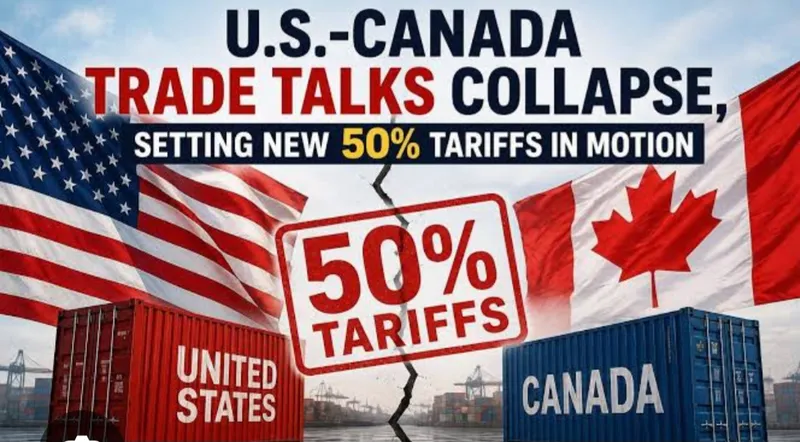
US-Canada Tariff Talks Collapse, Canada Announces Retaliatory Measures Against Trump’s 50% Tariffs
OTTAWA: Trade talks between the United States and Canada have ended without an agreement after several weeks of negotiations, triggering a fresh escalation in trade tensions between the two close allies. Following US President Donald Trump’s imposition of 50% tariffs on Canadian goods, Canadian Prime Minister Mark Carney has announced retaliatory measures against US imports on a “dollar-for-dollar” basis.
Carney said Canada would impose new counter-tariffs on a range of US imports from September 8, 2026. The Canadian prime minister said his government would take necessary measures to protect Canadian industries, businesses and workers from the impact of the US tariffs.
The US administration has imposed 50% tariffs on Canadian goods worth approximately $20 billion. The affected products account for around 5% of Canada’s total exports to the United States. The new tariffs cover products including alcoholic beverages, dairy goods, cement, electronics, furniture, paper products, textiles and various industrial and consumer items. Energy, potash and certain other key sectors have been exempted.
US and Canadian negotiators had been engaged in talks for several weeks, with prospects of a possible trade agreement emerging at one stage. According to Reuters, proposals under discussion included reducing US tariffs on Canadian-made vehicles from 25% to 15%, while tariffs on steel and aluminium were also being considered for reduction from 50% to 25%.
However, differences intensified during the final stage of negotiations over US demands and conditions. The Canadian prime minister described some of the US demands as unacceptable, arguing that certain conditions could have negative implications for Canada’s economy and national sovereignty.
Carney announced on August 21 that Canada was suspending trade negotiations with the United States and recalled Canadian negotiators to Ottawa. US Trade Representative Jamieson Greer, meanwhile, accused Canada of missing an important opportunity in the negotiations. US officials have not announced a schedule for a new round of talks.
Canada has decided to impose retaliatory tariffs on various US products from September 8 in response to Washington’s latest measures. Ottawa says the countermeasures are intended to offset the economic impact of US tariffs and protect Canadian industries.
Canada has already imposed retaliatory tariffs on certain US products. Duties remain in place on some US steel, aluminium and automobile-related products, while the Canadian government has also begun preparing support measures for industries and workers affected by the trade dispute.
The United States and Canada have highly integrated and mutually dependent economies. Around 70% of Canada’s exports are destined for the US market, making Canadian industries, employment and investment particularly vulnerable to higher US tariffs.
At the same time, the United States relies on Canada for a wide range of imports, including energy products. Supply chains in the automobile, energy, steel, aluminium and manufacturing sectors are deeply integrated between the two countries, meaning a prolonged trade dispute could create significant challenges for both economies.
The latest tensions could also affect the future of the United States-Mexico-Canada Agreement (USMCA). The three countries are preparing for a review of the trade pact, but the growing dispute between Washington and Ottawa has made the process more complicated.
Canada has not indicated any intention to end its long-term economic relationship with the United States. Instead, Ottawa is seeking to diversify its export markets and strengthen economic ties with other global partners. The Canadian government acknowledges that the United States remains its most important trading partner, but the current dispute has increased pressure to reduce Canada’s dependence on the US market.
There is currently no formal schedule for a new round of US-Canada trade negotiations. The United States has already imposed the 50% tariffs, while Canada is set to introduce its retaliatory measures from September 8. The developments have pushed trade relations between the two countries into a new period of uncertainty.
Analysts say a prolonged trade war could hurt businesses, industries and consumers in both countries because of their deep economic interdependence. However, with disagreements and a lack of trust continuing between Washington and Ottawa, the prospects for an immediate trade deal remain limited.