US Dairy Industry Plans $13 Billion Investment; Fewer Farms but Milk Production to Rise by 15 Billion Pounds
 By hanif sabir
Published: 15 Aug 2026
3 min read
By hanif sabir
Published: 15 Aug 2026
3 min read
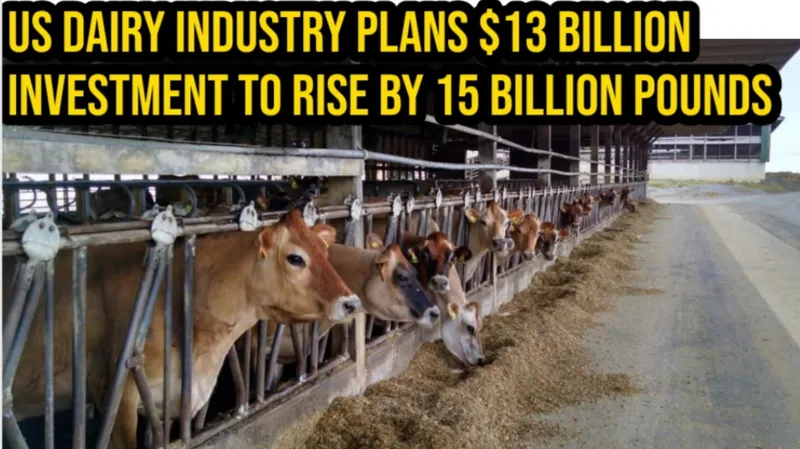
US Dairy Industry Plans $13 Billion Investment; Fewer Farms but Milk Production to Rise by 15 Billion Pounds
Washington, August 15: The US dairy industry is planning to increase milk production by approximately 15 billion pounds by 2030, with around $13 billion being invested in new and expanded dairy processing facilities across 19 states. At the same time, the number of dairy farms is expected to continue declining.
According to Dairy Herd Management, the investment by US dairy processors is aimed at expanding processing capacity to meet growing domestic and international demand for dairy products.
According to estimates by the US Department of Agriculture (USDA), annual US milk production is projected to increase from 225.9 billion pounds in 2024 to 243.7 billion pounds by 2030. Improved milk yields per cow and the adoption of modern farming technologies are expected to be the main drivers of this growth.
The USDA estimates that average annual milk production per cow will rise from 24,177 pounds in 2024 to 25,607 pounds by 2030, representing an increase of about 6 percent. Improved breeding, nutrition, animal care and data-driven farm management are expected to contribute significantly to higher productivity.
The report noted that the number of dairy farms in the US has been declining steadily, while larger and more productive farms are driving overall growth in milk production. The number of milk cows, estimated at about 9.34 million in 2024, is expected to reach 9.57 million in 2026 before declining slightly to around 9.52 million by 2030.
Of the planned $13 billion investment in dairy processing, New York is expected to receive the largest share at $2.8 billion, followed by Texas with $1.5 billion, Wisconsin with $1.1 billion, Idaho with $720 million and Iowa with $701 million.
By product category, approximately $3.2 billion is expected to be invested in cheese production, $2.9 billion in milk and cream processing, $2.8 billion in yogurt and other cultured dairy products, and about $1.6 billion in butter and milk powder production.
The report said demand for dairy products is also increasing in the United States. Per capita dairy consumption reached a record 661 pounds in 2023, while per capita cheese consumption has nearly doubled over the past five decades. Growing consumer interest in high-protein foods is also boosting demand for yogurt, cottage cheese, protein drinks and whey protein powder.
Export markets are expected to play an important role in the future growth of the US dairy industry. Latin America and Southeast Asia are being viewed as markets with significant growth potential, while countries including Saudi Arabia, the United Arab Emirates, Japan and South Korea are also seen as promising destinations for US dairy products.
According to the report, more than 60 percent of the new cheese produced in the US over the past two years was exported to international markets. USDA estimates suggest that the share of US milk production represented by exports, measured on a skim-solids basis, could increase from 21.5 percent in 2027 to 25.2 percent by 2035.
However, the US dairy industry continues to face challenges including labor shortages, climate change, drought, heat stress, feed and energy costs, trade policies and environmental regulations. Dairy producers in the European Union, New Zealand, Australia and South America also remain major competitors in global markets.
The report said that if processing capacity, infrastructure, labor and domestic and international demand remain aligned with rising milk production, the US dairy industry could be well positioned to absorb and market an additional 15 billion pounds of milk by 2030.