Solar Panels Helped Boost Grape Production by 277% in Italy’s Puglia Region
 By hanif sabir
Published: 23 Aug 2026
3 min read
By hanif sabir
Published: 23 Aug 2026
3 min read
Solar Panels Helped Boost Grape Production by 277% in Italy’s Puglia Region
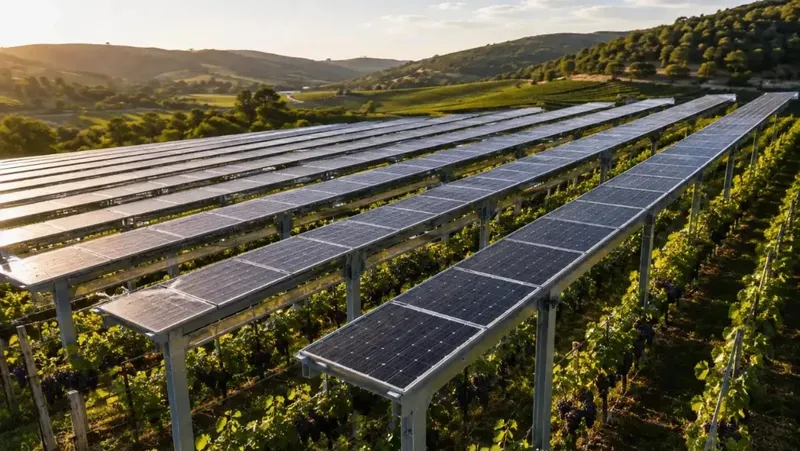
ROME: Researchers in Italy’s southern Puglia region have reported a remarkable increase in grape production after growing grapevines beneath elevated solar panels, offering fresh evidence that agriculture and renewable energy production can successfully share the same land.
The study found that grapevines grown under photovoltaic panels produced 277% more grapes than vines exposed to full sunlight. The research, published in the scientific journal Horticulturae in February 2025, examined how an agrivoltaic system affected the growth, productivity and surrounding microclimate of grapevines.
The approach, known as “agrivoltaics”, involves installing solar panels above agricultural land so that crops can continue to grow underneath while the panels simultaneously generate electricity.
Researchers from the University of Bari Aldo Moro studied grapevines in southeastern Puglia and compared vines growing beneath photovoltaic panels with vines growing under conventional full-sun conditions.
The results showed that the partial shade created by the solar panels significantly altered the growing environment. Soil beneath the panels retained more moisture and experienced more moderate temperatures, while wind speeds and atmospheric dryness around the vines were reduced.
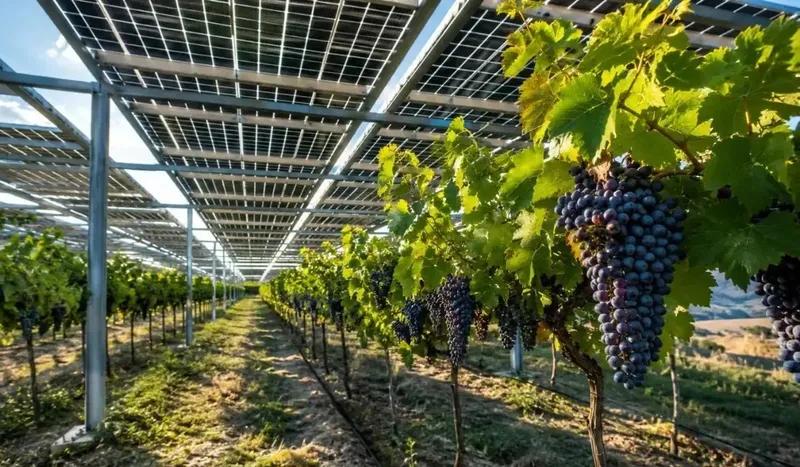
According to the research, these changes created a more favourable microclimate for the grapevines, helping them cope with heat and water stress.
The researchers also observed better fruitfulness of buds on the shaded vines, which contributed to the substantial increase in overall grape yield. The study found that the vines beneath the panels produced 277% more grapes than those exposed to full sunlight.
The findings are particularly significant for Mediterranean regions such as southern Italy, where agriculture is increasingly affected by rising temperatures, changing rainfall patterns, drought and soil-water shortages.
Instead of treating intense sunlight and heat solely as problems, agrivoltaic systems can use solar panels to moderate the conditions immediately around crops while converting sunlight into electricity.
The research also demonstrated the dual-use potential of the system. The same agricultural land was able to produce both grapes and solar electricity, potentially improving the overall productivity of the land.
The study reported a land-equivalent ratio of 3.54 for the agrivoltaic system, indicating a substantial combined benefit from agricultural and energy production compared with using separate areas for the two activities. The photovoltaic installation also generated more than 90% of the electricity associated with a comparable ground-mounted solar system.
Researchers caution, however, that the benefits of solar-panel shading cannot automatically be applied to every crop or climate. The amount of shade, panel height, panel configuration, crop variety and local weather conditions can all influence agricultural performance.
For crops that require intense sunlight, excessive shading could reduce yields. In hot and dry Mediterranean environments, however, carefully designed shading can help protect plants from heat and water stress.
The Puglia experiment therefore highlights a potentially important agricultural strategy for a warming world: rather than choosing between farmland and solar farms, the two can be integrated on the same land.
The concept could be particularly relevant to countries facing increasing temperatures and water scarcity, including parts of South Asia, the Middle East and Central Asia.
The Italian research suggests that solar panels may serve not only as electricity-generating infrastructure but also as a form of climate protection for crops.
With agriculture facing growing pressure from climate change and renewable energy requiring increasing amounts of land, agrivoltaics could become an important part of the future food-and-energy equation — producing electricity above the crops while the crops continue growing underneath.