Superpowers Must Accept Their Influence Has Diminished; They Can No Longer Impose Their Will on Other Countries, the World Has Changed: UN Secretary-General
 By hanif sabir
Published: 25 Aug 2026
5 min read
By hanif sabir
Published: 25 Aug 2026
5 min read
Superpowers Must Accept Their Influence Has Diminished; They Can No Longer Impose Their Will on Other Countries, the World Has Changed: UN Secretary-General
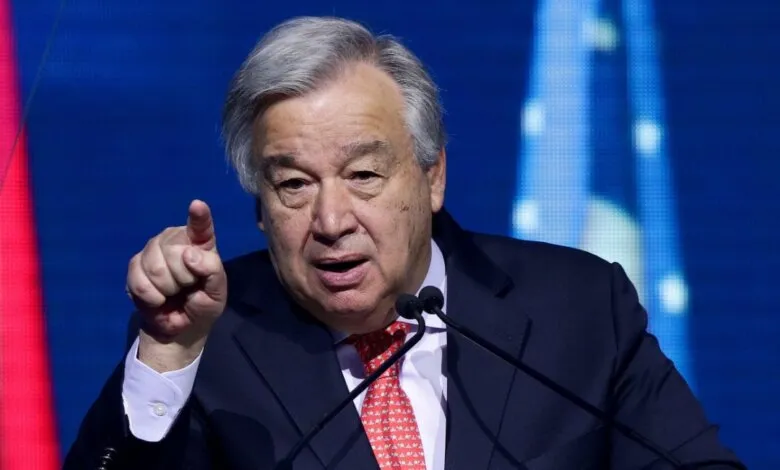
NEW YORK: United Nations Secretary-General António Guterres has said that the world has changed and major powers must accept that their power and influence are no longer what they once were. He said superpowers can no longer impose their will on other countries through military or political power as they did in the past.
In a detailed interview ahead of the end of his second and final five-year term, Guterres said the Russia-Ukraine war and the conflict between the United States and Iran had demonstrated the limits of the power of major states. He said the global balance of power is changing and the world is moving away from the post-Cold War system dominated by the United States toward a multipolar world.
Referring to the Russia-Ukraine war, Guterres said Moscow had expected a decisive victory within a short period after launching its full-scale invasion of Ukraine in February 2022. However, the war has continued for years and Russia has not achieved all of its objectives.
He also cited the conflict between the United States and Iran as another example of the changing global balance of power. According to Guterres, Washington had expected Tehran to retreat following attacks on Iran, but the Iranian government has remained in place and tensions in the region have continued. He said the situation demonstrates that it is no longer as easy for major powers to impose their will on other countries.
The UN chief said the developments should not be viewed simply as two separate conflicts, but as evidence of a broader transformation in the global power structure. According to him, the political, economic and diplomatic importance of several countries is increasing, while emerging powers are playing a more influential role in international affairs.
Guterres described the growing role of India, Gulf countries and other emerging powers of the Global South as an important development. He said international institutions must also adapt to the changing distribution of global power.
He stressed the need for reforms in global financial institutions, including the International Monetary Fund and the World Bank, saying their structures were created at a time when the balance of global power was very different from today. Their representation and decision-making mechanisms, he said, need to reflect present-day realities.
However, Guterres warned that a multipolar world would not necessarily be a more peaceful world. If international institutions fail to adapt and emerging powers are not given adequate representation in global decision-making, multipolarity could lead to increased competition, tensions and eventually confrontation.
Citing Europe before the First World War, he said the world was also multipolar at that time, but the absence of effective multilateral institutions allowed competition between powers to develop into a devastating conflict. The international community, he said, must learn from that history.
Guterres also called for reforms of the UN Security Council, arguing that its current structure does not adequately reflect the present global balance of power. The five permanent members — the United States, China, Russia, the United Kingdom and France — hold veto power, while three of the five permanent seats are held by European countries.
According to Guterres, changing realities will eventually require the Security Council to reflect the shifting distribution of global power, although reaching agreement on adding new permanent members will be extremely difficult.
The UN Secretary-General also questioned the idea of US President Donald Trump’s “Board of Peace” serving as an alternative to the Security Council. He said there was no strong basis for considering the new forum an effective replacement for the UN Security Council.
Guterres acknowledged that the United Nations is facing serious financial difficulties and political challenges. He said the organization has around $4 billion in outstanding payments, while the number of jobs was reduced by 22 percent in the 2026 budget. The number of troops deployed in peacekeeping missions was also reduced by 25 percent last year.
Despite differences with Washington, Guterres said the United Nations and the United States continue to cooperate on a number of issues, including Western Sahara, Libya, Sudan and the humanitarian crisis in Haiti. He noted that political statements and practical cooperation do not always follow the same path.
Reflecting on his nearly decade-long tenure, Guterres said one of the UN’s greatest achievements was helping prevent a new global war between major powers despite the numerous crises confronting the international system. He said the Secretary-General does not possess direct power, but does have a voice and the ability to bring countries together.
António Guterres is due to step down as UN Secretary-General in December 2026. His successor will inherit an international system facing growing tensions among major powers, demands for institutional reform, financial pressures and a rapidly changing global balance of power.